
West Bloomfield Township City Directory Shelves
Published directory evidence for West Bloomfield Township is a shelf-and-catalog task, not a promised continuous local run. The research found no official online list of West Bloomfield-only Polk or reverse-directory years, so a responsible search begins with the collection description and expands to Oakland County, Pontiac, and adjacent-community terms. The Library of Michigan directory guide identifies the major publisher families and explains that a title city can include suburban coverage. Its ANSWER catalog is the place to test several geographic names before treating a missing result as a missing household.
| Collection | Years | Where Held | Access |
|---|---|---|---|
| Polk directories | Some statewide holdings reach the late 1800s; exact township run not located | Library of Michigan and possible library-database access | Search ANSWER; verify suburban coverage |
| Bresser and criss-cross volumes | Generally late 1960s forward in the statewide guide; exact local run not located | Library of Michigan and county-library collections | Street and house-number research; ask about access |
| Other Michigan publishers | Exact West Bloomfield coverage not located | Library of Michigan special and general collections | Try Robinson's, Norton's, Johnson, W.C. Bailey, and Luedder |
| West Bloomfield local material | Local manuscripts, newspapers, microfilm, and donated ephemera; no directory run published | West Bloomfield Township Public Library | Ask staff about reference or archive handling |
| Historical maps and county collections | Maps from 1857 through 1947, plus county genealogy holdings | Greater West Bloomfield Historical Society and Oakland History Center | Online maps, research inquiry, or in-person collection work |
The coverage limits matter. Polk may bundle a suburb under another title, and Bresser volumes are often cataloged as county directories. An online search can also be restricted to an in-library database, an affiliate library, or a FamilySearch Center. Record the catalog title, volume year, geographic wording, and page before drawing a conclusion. Note: No published source found an unbroken West Bloomfield Township directory year run, so each volume needs a coverage check.
West Bloomfield Township Library Shelves
The West Bloomfield Township Public Library eResources page connects local researchers with FamilySearch, Library of Michigan material, newspaper finding aids, and obituary research routes. Its Main Library and Westacres Branch are practical local fallback points when a directory has no open web scan. Ask for an old telephone book, yearbook, local newspaper, township-history file, or street-name variant rather than assuming every historical source is labeled as a directory. Staff can also distinguish a circulating item from reference-only archival material.
The library's genealogy and newspaper resources provide the starting point shown below.
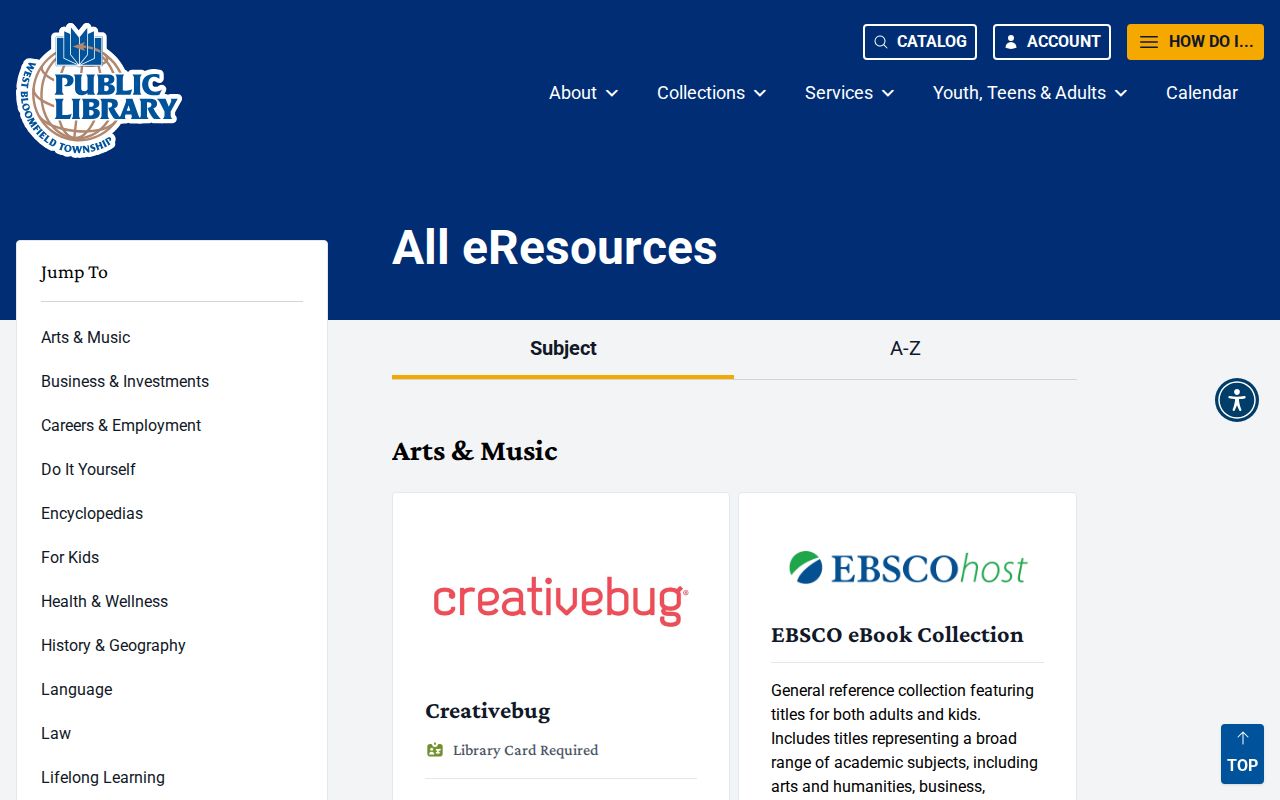
Use the collection links to locate supporting sources for a city-directory entry, then retain the repository and item details with the directory citation. A newspaper or obituary can clarify a move or death, but neither turns an unverified address into proof of a current connection.
The library history also places its local role in context. The institution began through the Keego-Cass Women's Club in 1934, its township funding measure passed in 1938, and the Main Library moved to its present building in 2000. Those dates can guide a search for board minutes, anniversary material, and donated local files whose catalog language differs from a modern city directory.
The West Bloomfield Township Public Library history is captured here as a local-institution reference.
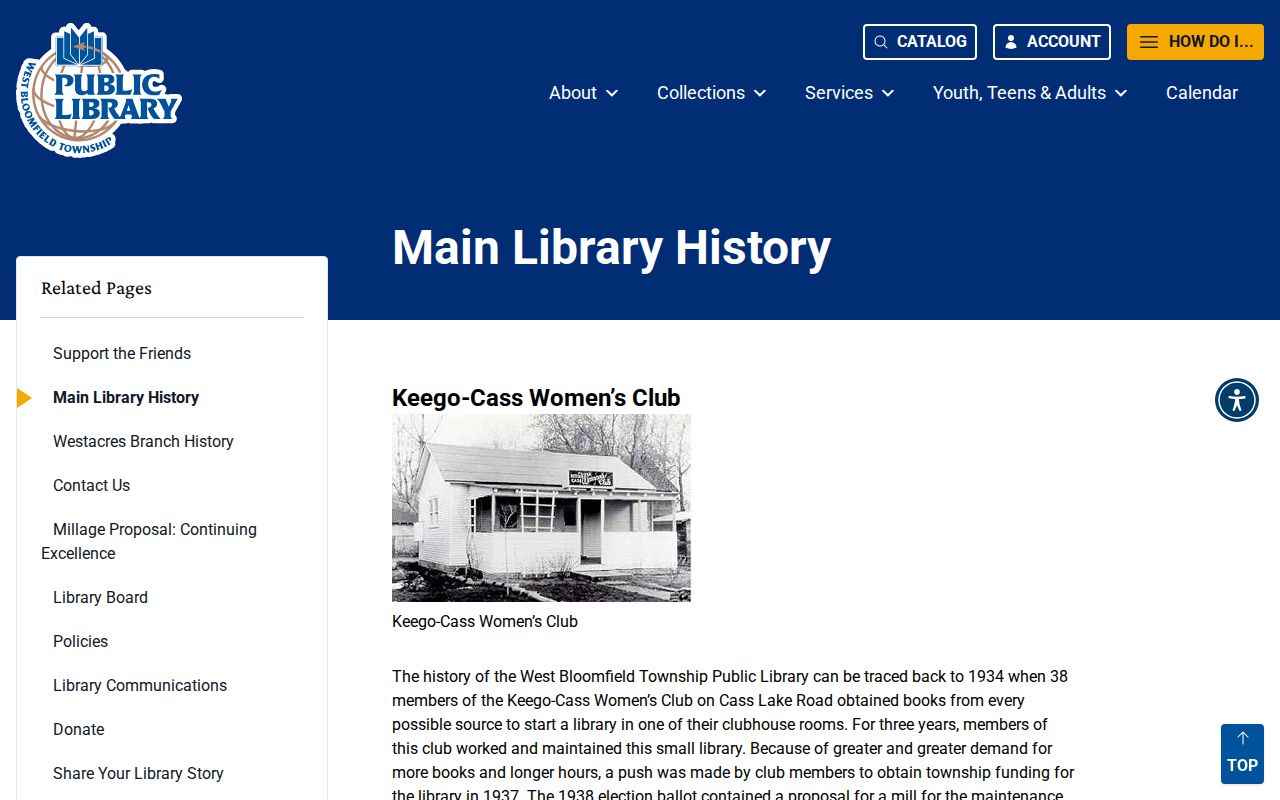
Institutional history helps date the kinds of civic material that may survive, but it is not a household list. Pair a library finding with its original directory, map, or government record before assigning it to a person or parcel.
Michigan City Directory Formats
The statewide directory guide is useful because it explains what different publishers put on the page. Polk surname sections may give a household head, other household members, occupation, address, and ownership status. The street section is arranged alphabetically by street and then house number. A telephone section, if present, usually identifies only the head of household. Business and classified pages add context, but a business listing can create a false residential match.
The Library of Michigan's city-directory overview describes Bresser volumes as a later reverse-address resource. They can include street order, telephone number, owner or renter notation, a first-listed year, and arrival or relocation notes. The guide notes that Bresser collections are often filed by county, which is especially important for a township search.
The Library of Michigan guide to city directories illustrates the publisher and collection framework used for the statewide shelves.
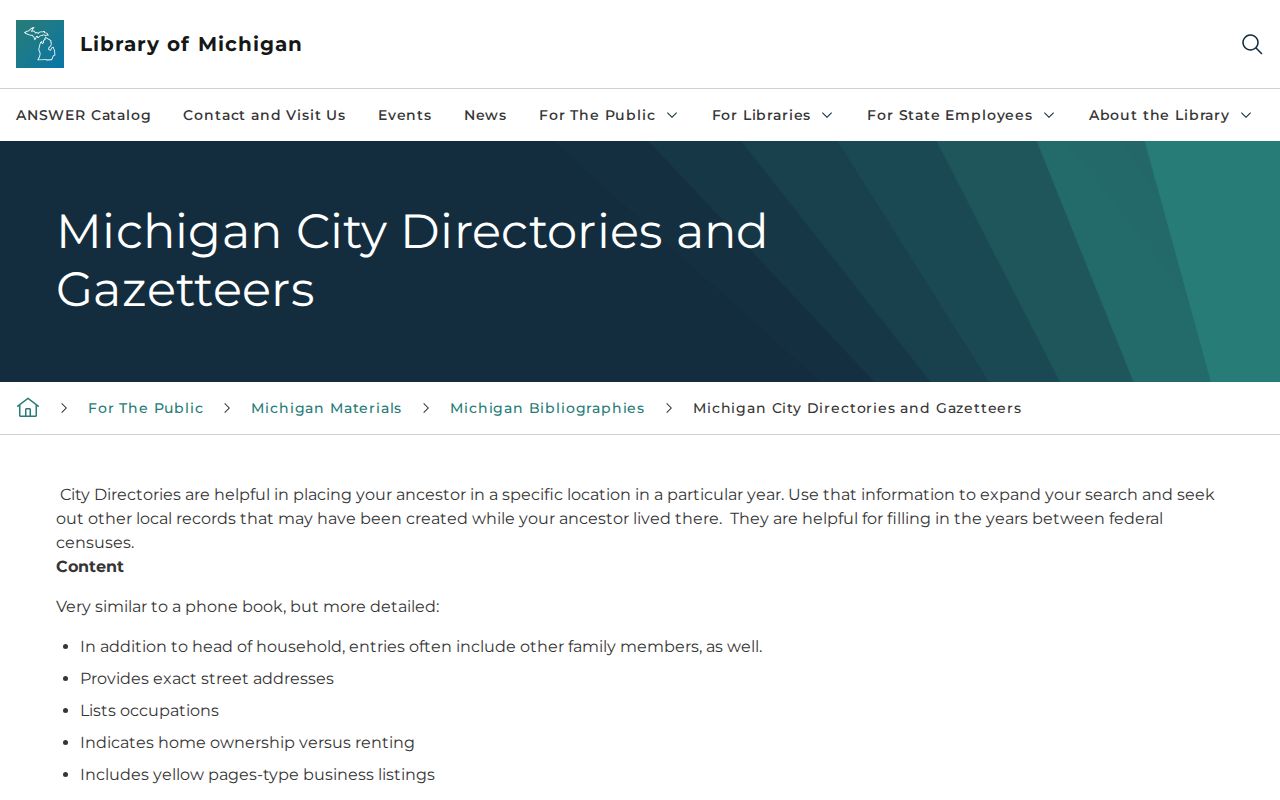
Search the catalog with both place and format terms: “West Bloomfield directory,” “Oakland County directory,” “Bresser Oakland,” and a nearby postal city. The exact volume, not the broad publisher description, determines which fields and streets are actually present.
Reading West Bloomfield Township City Directory Entries
An entry should be copied as evidence, not translated into a modern biography. Preserve initials, punctuation, parentheses, and the exact abbreviation. A surname section may supply a name, address, occupation, and related household clues, while a street section reverses the question: street first, then house number, then a listed head of household or business. Publisher choices vary by volume, so absence from one section does not prove a person was absent from the township.
| Name or initials | Copy the spelling, order, and punctuation exactly; name variants are common across years. |
|---|---|
| Occupation or business context | A lead for further research, not proof of a current role or home. |
| Address | A house number and street in the surname or street section, subject to the volume's geographic coverage. |
| Household clues | Some surname sections include other household members, while later reverse books often name only a head of household. |
| Owner or renter mark | A publisher notation that can suggest a relationship to the address, not legal title. |
| Telephone, first-listed, or relocation note | Fields that appear only in editions that include them; preserve them with the edition year. |
- Criss-cross directory
- A reverse directory organized by street and house number, commonly used to find the listed household head at an older address.
- Householder index
- A name-oriented section that may include the household head and selected members, depending on the publisher.
- Abbreviation key
- The volume's own guide to symbols and shortened terms. Photograph or transcribe it before interpreting a mark.
- Index versus image
- A catalog or search result points to a volume; the page image or physical page is the item that confirms what was printed.
West Bloomfield Township Directory Timeline
Directory research in West Bloomfield Township crosses several record eras. The defensible milestones are local history milestones and collection boundaries, not an invented first or last township directory year. Oakland County was organized in 1820, West Bloomfield became a separate township in 1833, and early land entries date to 1823. Later sources increasingly use street numbers, telephone exchanges, lake communities, plats, and PINs. The Register of Deeds computer and Super Index cutover begins in 1964, while older tract and manual records remain important for earlier property work.
- 1820s-1830s: land-entry, township, section, and metes-and-bounds language dominates.
- Mid-1800s: farms, roads, lakes, maps, deeds, tax records, and census material supply the stronger identifiers.
- Late 1800s to early 1900s: post-office, rural-route, plat, and city-directory terms begin to bridge household and property research.
- 1930s-1960s: street numbers, telephone exchanges, and Polk or Bresser formats become more useful where a volume covers the area.
- 1964 onward: PIN, legal subdivision, situs, mailing address, and recorded instruments connect the historical shelf to modern county records.
Note: A modern street number should not be pushed backward without checking the historic road, lake reference, section, and neighboring landowners.
Maps Beside West Bloomfield Township City Directories
Comparison. A directory names a listed person or household clue, while a map can place roads, buildings, and landowners in their period. The Greater West Bloomfield Historical Society map collection offers West Bloomfield maps for 1857, 1872, 1896, 1908, 1930, and 1947. Its local-history resource guide also identifies 1896, 1917, and 1936 maps that show landowners and buildings. That sequence is especially useful when a modern address is too new for an old directory.
Start with the directory surname or street, then compare the road, lake, subdivision, and nearby owners against the map. A historical map may identify a farm or lakefront tract rather than a numbered house. The next check is the plat or legal description, followed by the county tract and deed chain. The map and directory become complementary clues, not interchangeable proof.
The Greater West Bloomfield Historical Society local-history guide describes the map and manuscript leads behind this comparison.
For a current street-by-street ownership route, use the West Bloomfield Township Streets directory rather than treating an old printed entry as current parcel evidence.
Tracing West Bloomfield Township City Directories
Follow a household in both directions from a confirmed volume. Begin with a name or address, preserve the printed form, and compare nearby years before assigning a move. Census schedules are useful companions because they offer a household snapshot, while directories can fill the years between. The 1950 census is the latest decennial census generally public under the 72-year rule. Older West Bloomfield work may require a rural route, nearby post office, road, section, or lake name instead of a modern ZIP or street number.
- Locate the most recent available surname or criss-cross entry and note its exact page, year, address, and any mark.
- Check earlier and later volumes for spelling changes, a first-listed or relocation note, and a different street address.
- Pair the closest directory years with the census household, keeping age, relationships, occupation, and original spelling separate from later assumptions.
- Use the Oakland History Center for county directories, family histories, census, land, cemetery, and obituary collection leads.
- Test an address change against a historical map, legal description, deed, newspaper, obituary, or probate record before calling it the same household.
For the 1880-to-1900 census gap, the Oakland County Genealogical Society lists a 1890 Census Substitute project covering people found in 1884-1894 records. It can support a research lead, but the original collection and date still need to be cited. A disappearance may reflect a move, a death, different coverage, an unlisted household member, or a changed address system.
West Bloomfield Township Directory Boundaries
Historical directories are selective publications, not complete resident rolls. A listed owner, renter mark, telephone subscriber, business contact, or address does not establish every occupant of a home. The township's lake geography also complicates old descriptions. Pine Lake, Cass Lake, Walnut Lake, Orchard Lake, Westacres, Twin Beach, and Pine Lake Manor may remain stable local clues when street numbers, postal labels, or parcel lines change.
Use the narrowest accurate label: “listed in a directory,” “shown as a landowner on a map,” or “named in a newspaper.” Do not convert a mailing address, a board-minute appearance, or an obituary phrase into a current residence claim. When a source conflicts, retain the source date and ask the library, historical society, or record custodian for the relevant series and access conditions. Note: A gap in a directory can reflect coverage or indexing choices as easily as a household change.